
Professional Learning, Professional development, Teacher quality, Dissonance, Inclusive education, Reflective practice, Professionalism as a set of behaviors, Communities.
These are the key concepts I walked away contemplating following Cycle one’s readings. I have to say that I am still not clear why there needs to be a difference between professional development and professional learning. I see them as synonymous, yet the literature appears to describe them as differing. I have yet to reach this lightbulb moment of clarity. If you do not achieve professional learning, how can you achieve professional development? In simpler terms, if you don’t learn, how can you develop? Development requires learning, no?!…
In the Waitoller & Artiles (2013) article the mention of ‘teacher quality’ being “the single most important school variable influencing student achievement” had me rather baffled. As I commented in Hypothesis, in my childhood I was taught that everything depends on the student… Whenever I used the argument “the teacher this-or-that” I was told to look back at my own behavior and adjust accordingly. This was very frustrating at the time, yet I reaped the benefits later in life: I knew how to find answers by myself. It made me self-reliant and analytical. This leads me to focus on the importance of the culture we live in and our perception of it. If the student is the ground and the teacher is the sower with the seed. How can the sower plant in frozen soil? It seems one-sided to blame all outcomes on the teacher. I believe student/parent/learner expectations and abilities should be analyzed in tandem.
There were some very interesting responses to my observation. The conversation that ensued has been stimulating, exhibiting what may be one of the discrepancies in the perception of the role of the teacher. My personal expectations and wishes of a teacher and mentor are that she spark and harness curiosity, as well as encourage learning behaviors. In a talk by Sugata Mitra: https://youtu.be/y3jYVe1RGaU , Mr. Mitra breaks down education and what an educator/leader can be. He talks about the important role of curiosity and how much can be achieved by simply harnessing it and supporting it. An incredible idea, that can be one facet of a Leader’s persona. A facet of my leadership persona that I would like to hone into, harness and develop.
Dissonance was brought up in the conversations as well. Although we have discussed it in the context of professional development, resistance to what is different, new, and outside of our comfort zone is a well-known phenomenon. In the book “Thinking Fast and Slow” (2011) our decision-making leanings are discussed in depth. Our brains are wired for quick decision making, which favors the comfort of the well known and already explored. Even if facts and statistics may point toward the need for change, our “System 1” will bias us towards the quick and often unreliable/misleading choice. Hence, to balance aversive dissonance with motivating dissonance in order to achieve a learning environment will require active engagement from teacher/leader and student/learner alike.
The next concept that dug into my consciousness was the discussion of inclusive education. I full heartedly agree that inclusive education involves leaders/educators being “cultural vigilantes” (Corbett & Slee, 2000, p. 134) who always examine the margins.” (Waitoller, F. R., & Artiles, A. J. 2013). “Professional formation, much like other learning processes, must be understood in the context of interpersonal relationships and cultural values” (Hatem, D. S., & Halpin, T. 2019)
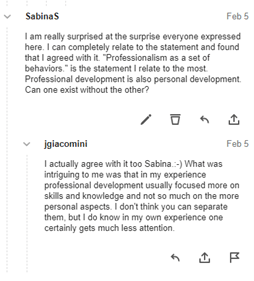
The understanding of the “other”. Dissecting the issue of exclusion, of otherness, would lead us into a major systems reform. How can we accept and understand “other” if we strive to standardize experience? When we measure according to one, biased standard? Inclusion in education would have to reflect a change in the sociocultural landscape. Can both be tackled at the same time? What will contextualizing professional development look like? Can we achieve some of it by integrating reflective practice into professional development and learning? It is surprising how limited the integration of this practice still is. To develop professionally we must develop personally as well. Challenging our views and habits, envisioning our future practices, and guiding our principles through examination, introspection and reality check-ins.
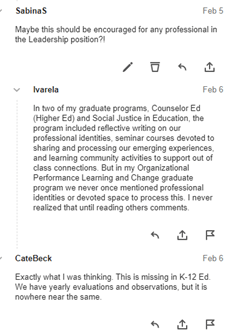
The whole person approach, the integrative approach may lead us in the direction of inclusive education and the kind of professional development that is not disjointed, but rather meaningful and applicable. “The system is simply not designed to care for people as a whole human with multidimensional needs, fears, and aspirations” (Hatem, D. S., & Halpin, T. 2019). This is true of systems across the board, not only in the medical system. I will once again go back to Mr. Mitra’s talk about when and how our systems were built and the fact that we have not actively revised them to incorporate the dynamic change of reality as it is now in 2021. Should we begin with an analysis of current needs as the development of technology would have it? It often feels like we are trying to fit a square peg in a round hole. We are trying to fit outdated systems into the needs of the present day.
In the article by Hairon, Goh, Chua, & Wang (2015), their examination of Professional Learning Communities speaks of shared values and vision. A question that came up for me and some of my colleagues was, is this necessary and if yes, in what capacity? What constitutes a community and how do we encompass its multidimensionality? In my opinion it should be the community in question that defines itself. “Constructs are human abstractions containing the essence of observed phenomena.” (Hairon, S., Goh, J. W., Chua, C. S., & Wang, L. 2015). “Leadership could also exist within PLC settings simply because leadership does not exist only at the principal or middle manager levels.” .” (Hairon, S., Goh, J. W., Chua, C. S., & Wang, L. 2015).
Finally, Opfer & Pedder was a very challenging and frustrating read. It made me doubt my ability to understand Scholarly articles and it confirmed my belief that exclusivity and elitism in scholastic circles have no place in 2021. A well written article will be understood by readers even if the theme is outside of their expertise. Overcoming the language of the article, I fully agree that “learning should be conceptualized as a complex system rather than as an event” (Opfer, V. D., & Pedder, D. 2011) In my experience this is applicable in all areas of professional development, not only teaching and education.
References:
Waitoller, F. R., & Artiles, A. J. (2013). A Decade of Professional Development Research for
Inclusive Education: A Critical Review and Notes for a Research Program. Review of
Educational Research, 83(3), 319-3356. DOI: 10.3102/0034654313483905
Hatem, D. S., & Halpin, T. (2019). Becoming doctors: Examining student narratives to
understand the process of professional identity formation within a learning community.
Journal of Medical Education and Curricular Development, 6, 238212051983454.
https://doi.org/10.1177/2382120519834546
Hairon, S., Goh, J. W., Chua, C. S., & Wang, L. (2015). A research agenda for professional
learning communities: Moving forward. Professional Development in Education, 43(1),
72-86. https://doi.org/10.1080/19415257.2015.1055861
Opfer, V. D., & Pedder, D. (2011). Conceptualizing teacher professional learning. Review of
Educational Research, 81(3), 376-407. https://doi.org/10.3102/0034654311413609
Mitra, S., 2013. [online] Available at: <https://youtu.be/y3jYVe1RGaU> [Accessed 11 February
2021].
Kahneman, D. and Egan, P. (2011). Thinking, fast and slow. New York: Farrar, Straus and
Giroux.

 Learning-Experience Design