
My takeaway: social context; multiple sources of influence; leadership capacity; nurture; foster; harness; collective; shifts in power; relational trust; not delegation; not a panacea.
“Instruction is best understood as constituted in the interaction of teacher, students, and material- what Cohen and Ball (1998) term the instructional unit.”
(Spillane (2001), p26)
I feel very inspired by this model! Leadership exists in an intersection; it is not a solo performance. Leadership is not individualistic, in fact the studies discussed throughout the readings for this cycle demonstrate that success is achieved when context, actor and artifact are all considered. All these are factors in achieving distributed leadership. In essence, the Leader is not the Director of the play. Or are they?
Let’s see: The play director creates a certain context, a certain interpretation, they have a vision and provide guidance and support. From there, they have to collaborate with the rest of the creators. The set designer, the actors, the producers, all co-lead in the creation. So, it isn’t delegation, it is collaboration. Then, maybe the distributive leader is very much like the director of a play.
Now, within the field of theatre, this is also up for debate, because there are many styles of directing. I just happen to prefer the style I described above.
Taking into consideration that “human activity is best understood by considering both artifacts and actors together through cycles of task completion because the artifacts and actors are essentially intertwined in action contexts (Lave, 1988).” (Spillane (2001), page 23) gives me hope. As referred to on page 26 of Spillane’s article, what should be considered a backdrop to Leadership is currently used as defining elements. Meaning? We have it backwards? But distributed leadership is not the opposite of the any current model? It seems this is dependent on interpretation, which would result in variable results. What are the concrete models used in Finland? Or in any of the other countries listed as examples of functional and successful distributed leadership model. I will dig into this futher.
I am also of the belief that Leadership is more than the sum of its parts. In my experience, across multiple fields, the best experience of Leadership has been the leader-guide. The Maestro that has a vision but sees everyone as equal parts magic; equal parts creators. The Leader holds the space. Because “even when a particular cognitive task is undertaken by an individual apparently in solo, the individual relies on a variety of sociocultural artifacts such as computational methods and language that are social in origin (Wertsch, 1991). (Spillane (2001), page 23)
The criteria examined in Jones (2012) makes sense. But it also seems rather nebulous.
Criteria for Distributed Leadership:
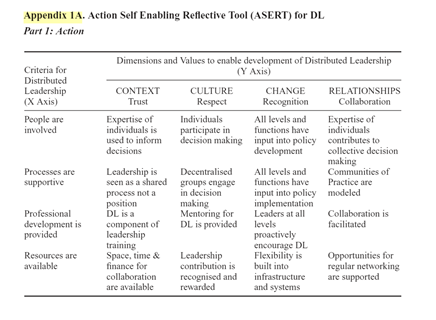
- People are involved
- Processes are supportive
- Professional development is provided
- Resources are available
I suppose that is why “further research is required into how academics, executive professional and administrative staff may be supported to develop more effective distributed leadership approaches to change.” (Jones (2012), p74). Very curious about this. Nine years later, I wonder if we do have some of that research?!
Harris (2013) raises some considerable obstacles to distributed leadership. The need for support from formal leadership, which in my case would be the hospital’s hierarchical administration. The immediate need for organizational change, policy frameworks and the centering of inequalities across organizations. As she points out the latter still has not taken center stage, where it well belongs.
There is also the important distinction between “distributed leadership as task distribution and distributed leadership as distributed influence processes (Harris (2013); page 4.) A misinterpretation that makes me wonder if this leadership style needs a more refined, finessed name. A specific that cannot be confused. A name that lay at the intersection of collaboration, co-leadership; context iteration and re-iteration, and management.
I love that she points out the power leaders have within their reach and how delicate the balance between key barer and gate keeper can be. The distributive leader, as I understand it would focus on cultivating; creating and supporting patterns of distributed leadership practices.
So much to elaborate on within this text. I will come back.
References
Harris, A. (2016, April 20) Professor Alma Harris, distributed leadership [Video]. Youtube. https://www.youtube.com/watch?v=biPC_IJyiHo
Jones, S., Lefoe, G., Harvey, M., & Ryland, K. (2012). Distributed leadership: A collaborative framework for academics, executives and professionals in higher education. Journal of Higher Education Policy and Management, 34(1), 67-78. DOI:10.1080/1360080X.2012.642334
https://docdrop.org/pdf/Distributed_leadership_a_collaborative_framework_2016-XtSGa.pdf/
Spillane, J. P., Halverson, R., & Diamond, J. B. (2001). Investigating school leadership practice: A distributed perspective. Educational researcher, 30(3), 23-28. https://docdrop.org/pdf/Investigating_School_Leadership_Practice-_2001-Yujpd.pdf/
Harris, A. (2013). Distributed leadership: Friend or foe? Educational Management Administration & Leadership, 41(5), 545–554.
https://docdrop.org/pdf/DL_Friend_or_Foe__Alma_Harris_2013-DBkJM.pdf/

 Learning-Experience Design